
1
Understand the loop
Pre-sleep cognitive arousal — worry, planning, replaying and monitoring — is associated with difficulty switching off.

Because a switched-on mind needs more than another generic sleep track.
Most people do not arrive at bed with a blank mind. They arrive with unfinished thoughts, worry, replaying, planning or pressure that is still switched on.
Sleep research shows that this kind of pre-sleep cognitive activity matters. That is where Ethereal Flow starts.

We were already using meditation, sleep audio, breathing techniques and other tools in our own lives. Some of them helped. Some of them didn’t. And the more we looked into it, the more obvious it became that the hard part wasn’t finding techniques — it was knowing which ones were right for you, when to use them, and how they should work together.
We both became increasingly fascinated by sleep science, neuroscience, psychology and the different ways people can change how they respond at night. We kept reading, testing and comparing approaches, partly because we wanted to understand it for ourselves.
What struck us was how much useful work was already out there, but how much of the responsibility was still left with the person lying awake at night to somehow piece it all together. Most people are busy. They are already trying their best. They shouldn’t need to become an expert in sleep science just to work out what might help them.
That was the frustration that led us to build Ethereal Flow.
We wanted to take what we were learning, what had helped us, and the research behind it, and turn it into something much simpler: a personalised protocol that does the thinking for you.

There is no shortage of sleep content. Meditation, breathing exercises, affirmations, visualisation, sleep stories, apps and courses — there is an enormous amount to choose from.
The difficulty is knowing what actually applies to you.
If your mind is racing at night, are you trying to calm your body, interrupt a thought pattern, redirect your attention, work with a belief, use imagery — or combine several approaches in a particular order?
Most people do not have the time, or the reason, to work all of that out for themselves.
Ethereal Flow was built to take away that hard work — to use your answers to understand your individual night-time pattern, then determine the right techniques, sequence, language and pacing for one Personalised Sleep Protocol built specifically for you.

We became obsessed with understanding what actually works. We immersed ourselves in the research across the disciplines that matter most.
Rehearse a different response.
Mental simulation produced a reliable positive effect on subsequent behaviour. The systematic review and meta-analysis covered 94 studies, 5,685 participants and 123 effect sizes. In sleep-specific research, pre-sleep imagery reduced unwanted cognitive activity and shortened sleep-onset latency relative to no instruction.
For a mind caught in the same night-time loops, that matters: the goal is not simply to suppress the thought. It is to give the mind a different response to practise.
Cole et al. (2021). “Synthesizing the Effects of Mental Simulation on Behavior Change: Systematic Review and Multilevel Meta-Analysis.”
Supporting sleep study: Harvey AG, Payne S. (2002). “The management of unwanted pre-sleep thoughts in insomnia: distraction with imagery versus general distraction.” Behaviour Research and Therapy.
What you practice before sleep can matter after lights out.
Sleep does more than switch the brain off. It plays an active role in processing and consolidating what we’ve recently learned and experienced. Research shows that memories can be reactivated and reorganised during sleep, helping recently encoded learning become more established.
That’s why repetition matters. Your protocol gives you the opportunity to practise a different response before sleep, while sleep itself supports the brain’s natural process of memory consolidation.
Diekelmann S, Born J. (2010). “The memory function of sleep.” Nature Reviews Neuroscience, 11:114–126.
Brodt S, Inostroza M, Niethard N, Born J. (2023). “Sleep—A brain-state serving systems memory consolidation.” Neuron, 111(7):1050–1075.
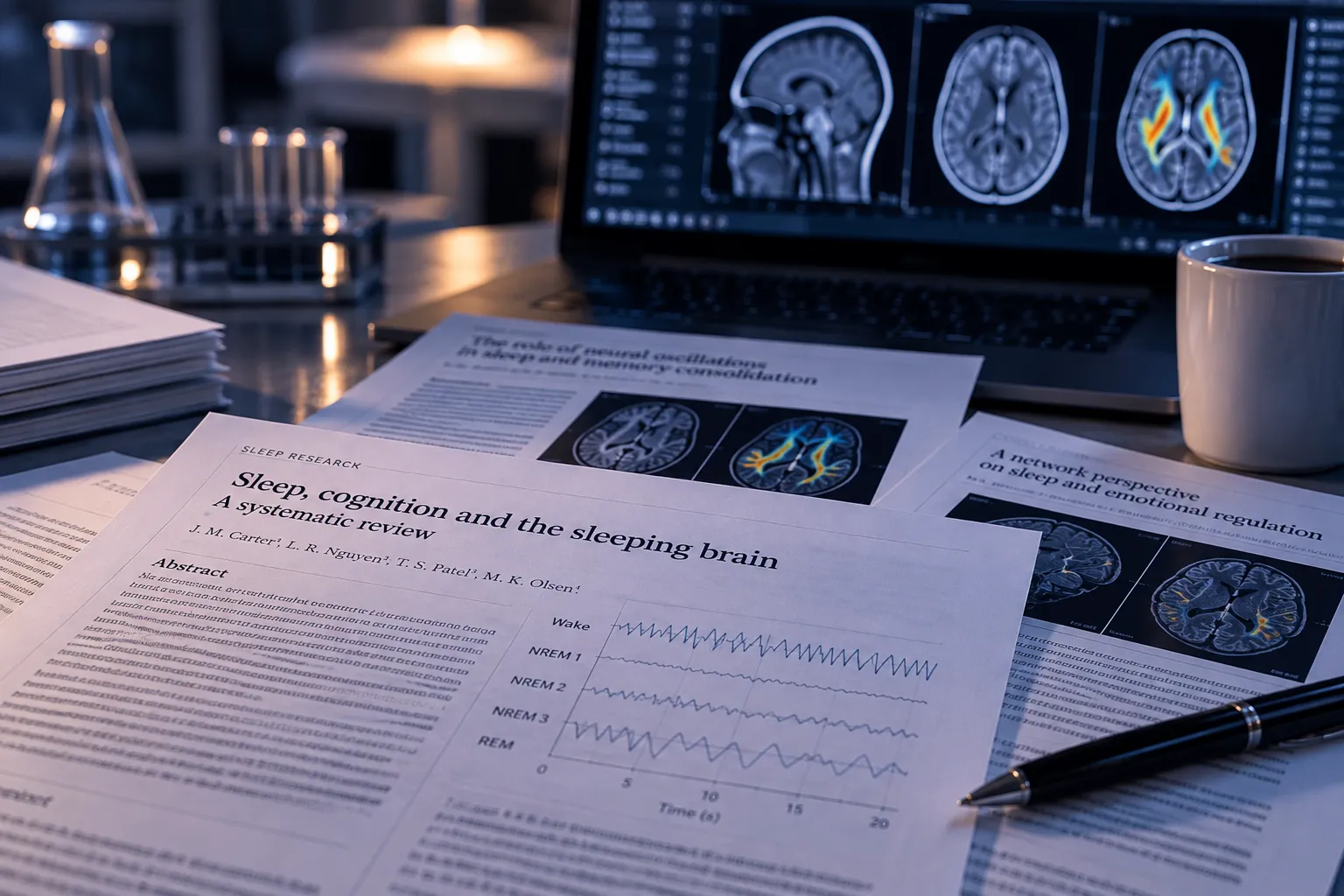
The science tells us what works. Flow Codex™ determines what matters for you.
We built Flow Codex™ to turn a deep body of sleep science, psychology and behavioural research into one precisely designed Personalised Sleep Protocol.
It takes your assessment, identifies the pattern within your answers, and makes the detailed decisions that shape your protocol: the techniques, sequencing, language, imagery, repetition and pacing, so every element works together deliberately.
Behind that process sits a wide research base and a deep library of possible approaches. The value of Flow Codex™ is not simply having those options. It is knowing how to interpret your answers and combine the right elements in the right way for you.
Nothing is generic. Nothing is arbitrary. Every decision has a reason.
Your pattern. Your priorities. Your protocol.
The science is not decoration. It shapes the order of the experience.

Pre-sleep cognitive arousal — worry, planning, replaying and monitoring — is associated with difficulty switching off.
Breathing, relaxation and body-settling can support physiological calm-down regulation and create a better starting state.
Established psychological sleep approaches work with thoughts, beliefs and responses rather than relying only on passive relaxation.
Guided imagery and mental rehearsal give attention a coherent direction and can support practising alternative responses.
Repeated practice supports learning. Sleep is an active period of memory processing and consolidation.
Flow Codex™ uses your answers to determine which evidence-informed mechanisms, pacing, language, imagery and sequence are most relevant for your pattern.
This page gives the practical summary. The full evidence base goes further.
The method draws on established research across sleep science, psychology, cognitive behavioural research, relaxation, guided imagery, learning and memory. Below are six of the core research areas shaping the approach.
Want to explore the science further?
These are just six examples from the wider body of research behind Ethereal Flow. Explore the evidence, studies and scientific foundations in more detail.
Ethereal Flow is built on a genuine commitment to science, transparency and your trust. Here is what that means in practice.
Our protocols are informed by established research across sleep science, neuroscience, psychology, cognitive behavioural research, guided imagery, learning and memory.
We use evidence-based methods with a proven track record of supporting changes in thought patterns, emotional regulation and sleep quality.

Ethereal Flow provides personalised sleep protocols for general wellbeing. We do not diagnose, treat, cure or prevent medical conditions, and our content is not a substitute for professional medical advice.
We use research-informed mechanisms to guide how protocols are constructed, but we do not claim that Flow Codex™ itself has been clinically proven as a complete intervention.

We are transparent about the research, methodology and overall approach behind Ethereal Flow.
What we do not publish is the internal interpretation logic, route-selection rules, technique mapping, sequencing framework and scoring system that make up Flow Codex™.
This protected system is what allows us to turn the science into a genuinely personalised experience.

We want you to understand what we have built, why we built it and the evidence behind it — without asking you to take any of it on faith.
Start with the assessment. Flow Codex™ does the heavy lifting from there.